This is an old revision of the document!
1.1 A First Problem: Stable Matching
The Stable Matching Problem originated from two mathematical economists, David Gale and Lloyd Shapley, who wanted to understand if it was possible to design a job recruiting process that was self-enforcing?
In other words, “Given a set of preferences among employers and applicants, can we assign applicants to employers so that for every employer E, and every applicant A who is not scheduled to work for E, at least one of the following two things is the case?
- E prefers every one of its accepted applicants to A; or
- A prefers her current situation over working for employer E” (3).
Because individuals act in self-interest, a system designed as noted above would create a stable environment, as applicants and employers will not make deals behind the scenes.
Problem Formulation
For simplicity, we assume there are n companies, n applicants, and each company accepts only a single applicant.
There are two sets, M and W. M and W represent two distinct groups, whether that be companies and applicants or men and women. M x W represents the set of all possible ordered pairs. There are then two options for sets:
- Matching: S is a set of ordered pairs, each ordered pair from M x W, where each member of M and each member of W appear in at most one pair in S.
- Perfect Matching: S is a set of ordered pairs, each ordered pair from M x W, where each member of M and each member of W appear in exactly one pair in S.
Stable: a matching S is stable if:
- it is perfect
- there is no instability with respect to S
An instance can have more than one stable matching.
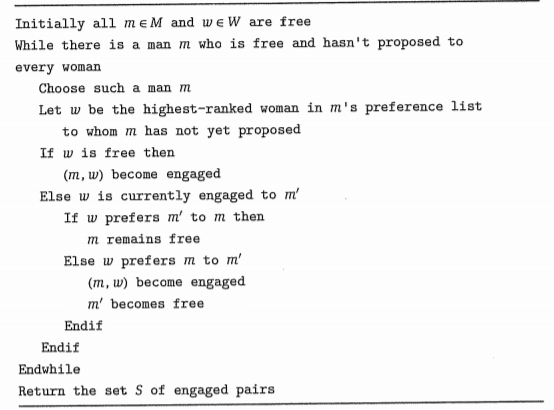
Brief Sketch