This is an old revision of the document!
Chapter 6
- In general, most problems do not have a natural greedy algorithm solution that works
- Divide and conquer is often not strong enough to reduce exponential brute-force search down to polynomial time
- Dynamic Programming: one implicitly explores the space of all possible solutions, by decomposing things into a series of subproblems, and then building up correct solutions to larger and larger subproblems
6.1 Weighted Interval Scheduling: A Recursive Procedure
- Each interval has a certain value (or weight), and we want to accept a set of maximum value.
Designing a Recursive Algorithm
- n requests (1,…,n)
- each request i specifies a start time si and finish time fi.
- each request i also has a value or weight (vi)
- compatible intervals: do not overlap
- goal: select a subset of mutually compatible intervals so as to maximize the sum of the values of the selected intervals
- sort requests in order of nondecreasing finish time
- define p(j), for an interval j, to be the largest index i<j such that intervals i and j are disjoint
- leftmost interval that ends before j begins
- p(j) = 0, if no request i<j is disjoint from j
- Optimal solution O: either interval n belongs to O or it doesn't
- if it is, no intervals indexed between p(n) and n can belong to O
- if it is not, O is equal to the optimal solution of request s {1,n-1}
- For any value of j between 1 and n, let Oj denote the optimal solution to the problem consisting of requests {1,…,j} and let OPT(j) denote the value of this solution
- OPT(j) = max(vj + OPT(p(j)), OPT(j-1))
- request j belongs to an optimal solution on the set {1,2,..,j} if and only if vj + OPT(p(j)) >= OPT)j-1)
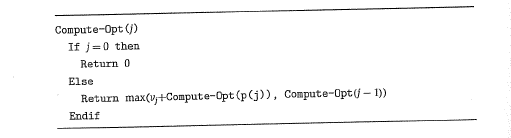
- Compute-Opt Subproblems grow very quickly
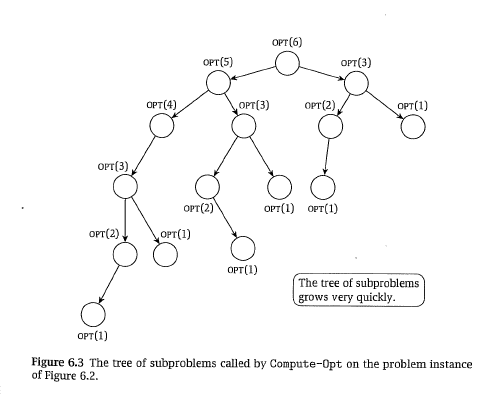
- we have not achieved a polynomial-time solution
Memoizing the Recursion
- Previous algorithm runs in exponential time because of the redundancy of how many times it issues a compute-opt() call
- Memoization: saving values that have already been computed in a globally-accessible place
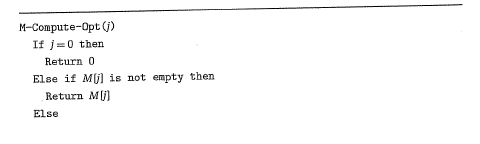
- Have an array M[0…n], where M[j} will start with the value “empty” and then will store the value of Compute-Opt(j) as soon as it is first determined.